HYDieCasting


Summary:Sample approval does not automatically guarantee stable mass production. Plating blisters, batch-to-batch color variation, loose fitment, inconsistent magnetic feedback and delivery delays can originate in design, die casting, finishing or assembly. This guide helps procurement managers, product engineers, packaging designers and manufacturers select materials, review designs, evaluate a Zamac perfume cap manufacturer and reduce risk before tooling a custom zinc alloy perfume cap.
The Short Answer: Cap Problems Usually Do Not Come From One Process Alone
The pump head, internal plug, magnets, key dimensions, visible surfaces and surface finish requirements were not finalised prior to mould opening.
Irregular shapes, deep cavities, thin-walled structures or those with significant variations in wall thickness may increase the risk of porosity and insufficient filling.
There are no written standards for colour samples, gloss, polish grades, mounting points and test conditions.
Samples are assessed solely on their appearance, but issues with assembly, wear resistance or batch consistency only come to light during mass production.
When selecting a zinc alloy perfume cap manufacturer, do not ask only whether the supplier can make the part. Ask whether design, tooling, die casting, finishing, assembly and approval can be connected through a traceable process.
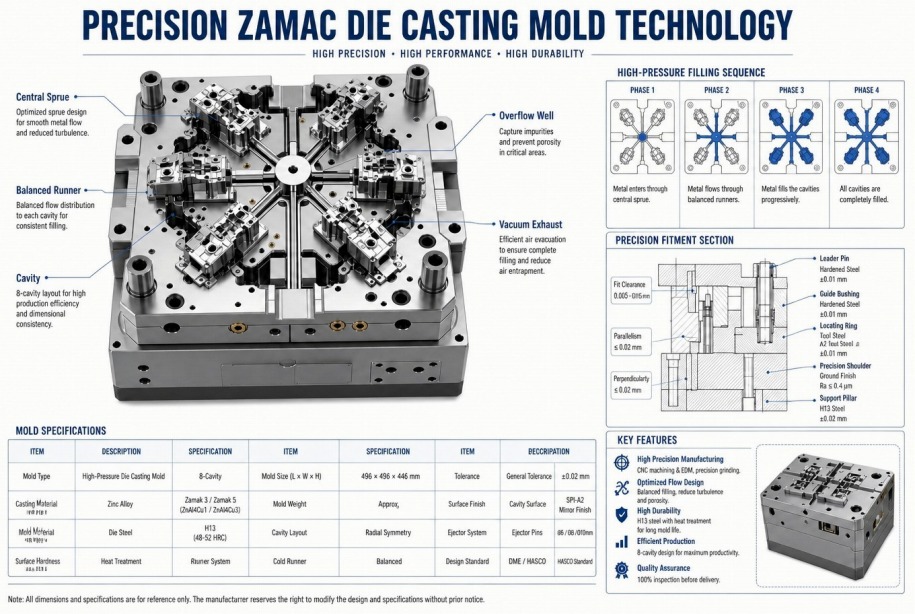
For custom metal perfume caps, a visible problem may appear during electroplating even when its root cause began earlier. If the runner, overflow and venting design do not match the part geometry, air can become entrapped inside or near the surface. The issue may later appear as pinholes, blisters or inconsistent coating adhesion during polishing, cleaning, baking or plating.
1. Map the defect location: cosmetic face, parting line, thick section or gate area.
2. Compare die-casting, polishing and plating batches to identify any batch pattern.
3. Review runner, overflow, venting and mold-temperature records; use section analysis when appropriate.
4. Recheck pretreatment, cleaning, baking and sealing rather than automatically blaming one process.
5. Record the corrective action in the first-article and production inspection standards.
For mirror plating, gold finishes or intricate relief structures, discuss vacuum-assisted die casting with the supplier. It is not automatically required for every project; its suitability should be assessed against geometry, finish requirements, volume and cost targets.
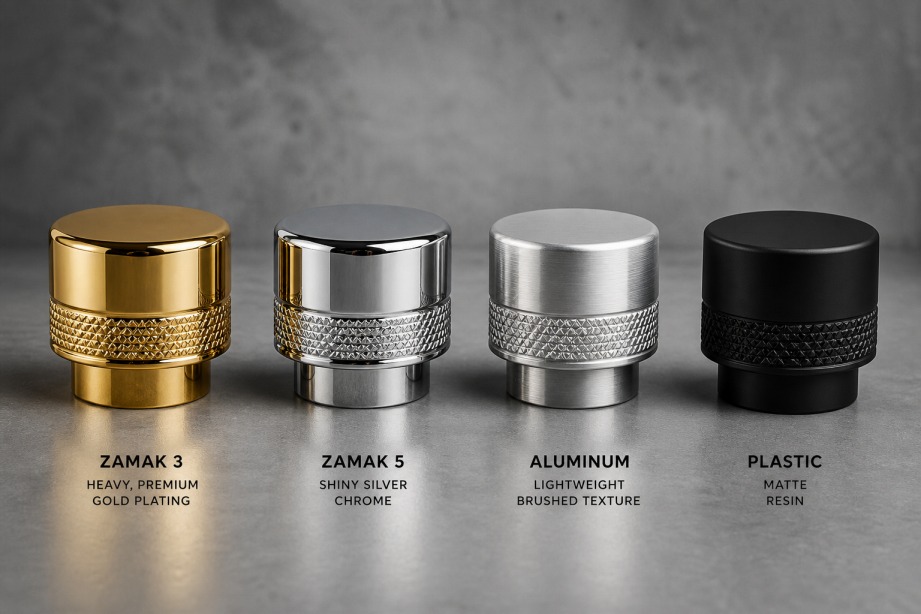
Material selection should not be based only on density or unit price. Geometry, finishing, structural requirements, target weight and volume should be considered together. The table below supports early discussion and does not replace a project-specific material review.
| Option | Main characteristics | Considerations | Typical fit |
| Zamak 3 |
Moulding details and surface finishes are generally well-balanced; suitable for bespoke decorative components |
Pre-treatment prior to pore control, polishing and electroplating is still required |
Bespoke perfume bottle caps, embossed casings and intricate decorative fittings |
| Zamak 5 |
Suitable for structures requiring higher levels of strength or hardness |
This must be confirmed in conjunction with the design, surface treatment and assembly requirements. |
Components subject to high structural loads or requiring high wear resistance |
| Aluminum |
It is relatively light, making it suitable for lightweight applications |
The texture, moulding details and surface finishes differ from those of zinc alloys |
Lightweight bottle caps and other aluminium alloy die-cast components |
| Plastic/Resin |
Greater flexibility in terms of weight reduction and cost control |
The weight, durability and decorative effects of metals vary |
Packaging solutions that are more sensitive to weight or cost |
If you are comparing Zamak vs aluminum perfume caps, first confirm four points: target weight, required finish depth, fine relief or hollow features, and the shell-to-insert fixing method. These answers matter more than asking which material is simply “more premium.”
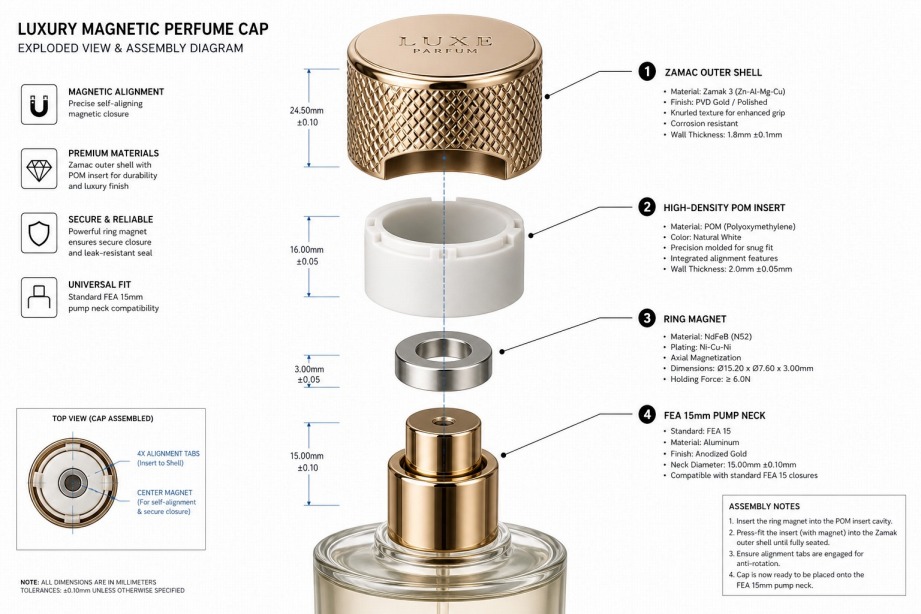
The performance of magnetic perfume bottle caps depends on the shell, insert, magnet, pump and bottle neck together. Controlling only the outer shell does not guarantee the final closure behavior.
Pump model and actual fitment dimensions;
FEA 15mm, FEA 18mm or other neck requirements;
Insert material, such as PP, POM or a specified grade;
Magnet size, polarity and retention method;
Datum, measurement location and allowable range for critical dimensions;
Target insertion force, pull-off force or closure feedback.
“±0.02 mm” should not be used without identifying the measured feature. The drawing should define the critical dimension, datum, inspection method and applicable area. This is how precision fitment becomes an executable engineering requirement.
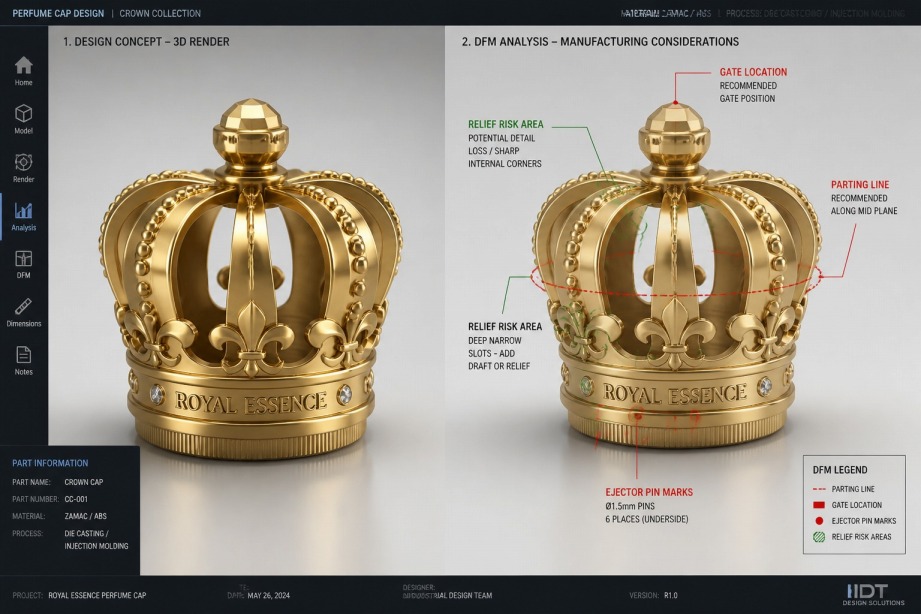
A visual concept can look excellent, but perfume cap design for manufacturing must translate that intent into manufacturable geometry. Before tooling, confirm:
1. Keep the parting line away from the logo and primary cosmetic faces.
2. Define acceptable locations for ejector, gate and rack marks.
3. Check draft and manufacturability for relief, engraving and fine lettering.
4. Review whether hollow features create weak connections or filling difficulty.
5. Confirm that polishing access supports the intended gloss on curved surfaces.
6. Use physical color, texture and gloss samples rather than screen images alone.
7. Reserve assembly space for the insert, magnet and pump.
8. Define acceptable cosmetic-defect limits for critical visual areas.
3D file in STEP, IGES or an accepted format;
2D drawing with critical dimensions, tolerances and datums;
Pump and bottle-neck information;
Target quantity, annual forecast and first-order quantity;
Preferred or proposed material;
Finish sample, color reference and gloss requirement;
Insert, magnet and assembly requirements;
Compliance, packing and delivery requirements for the target market.
Does tooling include a DFM review?
How are critical dimensions measured and recorded?
How are production standards locked after sample approval?
How is color compared between plating batches?
How are nonconforming parts classified, isolated and traced?
Can material, finishing and inspection records be provided?
What are the risks and alternatives for complex geometry?
How will packaging reduce friction, moisture and impact in transit?
This checklist also applies when sourcing a Zamac perfume cap manufacturer, metal perfume cap factory or wholesale perfume bottle caps supplier.
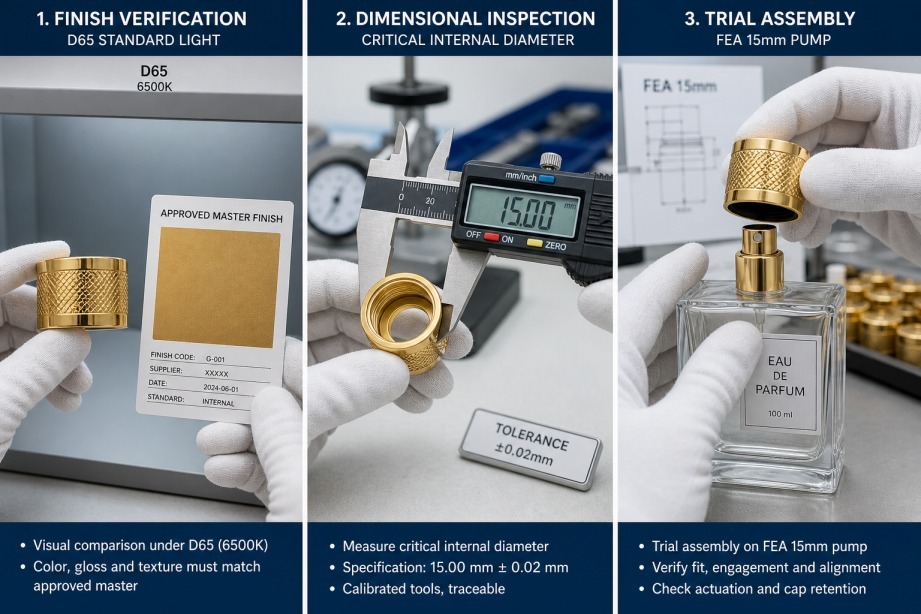
Check pores, pinholes, blisters, scratches and color variation under the agreed light source.
Check parting, ejector and rack marks against the agreed cosmetic limits.
Compare the sample side by side with the approved master sample.
Measure cap height, cavity, critical fitment dimensions and wall thickness.
Test-fit with the actual pump and bottle.
Check looseness, alignment, insertion force, pull-off force and closure feedback.
Check magnet retention and insert assembly.
Confirm that electroplating, PVD, coating, brushing or another finish matches the approved sample.
Perform alcohol rub, adhesion, salt-spray or synthetic-sweat tests when required by the project.
Record the method, duration, temperature, observations and sample identification.
Use the approved first article to establish acceptance criteria.
Define sampling and nonconformance handling.
Confirm traceability for batch numbers, material records and finishing records.
Perfume cap surface finishing should be selected against appearance, durability, cost, volume and environmental requirements. Electroplating, PVD, coating, brushing and localized decoration each have different applications. For gold plated perfume caps, gunmetal, matte black or custom-logo caps, a color name alone is not an acceptance standard. Also define:
Color and gloss comparison conditions;
Substrate polishing grade;
Protective topcoat or sealing method;
Adhesion, abrasion, alcohol or salt-spray requirements;
Rack points, masked areas and acceptable cosmetic boundaries.
When the cap must interface with a glass bottle, pump, insert or gift box, suppliers should also confirm fitment datums, secondary-process sequence, incoming inspection, batch traceability, inner and outer packaging, moisture protection, delivery documents and change-notification procedures.
Possible causes include entrapped porosity, pretreatment, polishing, the coating system and baking conditions. Identify the source through appearance review, section analysis or process records rather than automatically blaming plating. For complex cosmetic parts, review runner, overflow and vacuum-assisted die-casting options during DFM.
There is no universal answer without reviewing the drawing and finish requirements. Zamak 3 is often considered when a balance of detail reproduction and finishing is needed, while Zamak 5 may suit designs with higher strength or hardness requirements. Confirm the final choice through project evaluation.
Not necessarily. FEA 15mm is a specification, but actual fitment also depends on the pump, bottle neck, insert and internal cap geometry. Provide the actual pump model, critical dimensions or a sample and validate fitment through assembly testing.
Lock the physical master sample, substrate condition, finishing route, measurement conditions and acceptance range. Record lighting, viewing angle, gloss and batch information during approval instead of relying only on screen images or color names.
Suppliers usually need a 3D file, a 2D drawing with critical dimensions, pump and bottle-neck information, target volume, finish samples and insert or magnet requirements. Confirm accepted file formats and project requirements at the start.
It can be evaluated, but suitability depends on tooling investment, geometry, target volume, finish and future scaling plans. For low MOQ perfume packaging, compare tooling, sampling, unit and future scaling costs rather than looking only at the first-order unit price.
Evaluate insert material, interference fit, magnet retention, assembly method and shipping impact together. Define target insertion, pull-off or closure-force ranges during design and validate them through sample and first-article assembly tests.
At minimum, traceability can link the material batch, die-casting batch or date, finishing batch, inspection records and packing batch. Define exact fields according to project risk, order volume and the customer’s quality system.
For procurement managers, a reliable supplier should help reduce hidden costs rather than provide a unit price alone. For engineers, the key is to convert pump, insert, magnet, tolerance and finish requirements into executable engineering documents. For packaging designers, the goal is to make the concept manufacturable within parting, ejection, polishing and assembly constraints. For manufacturers, clear quality, traceability and delivery interfaces are essential.
If you are evaluating custom Zamac perfume caps, magnetic perfume bottle caps, FEA 15mm perfume caps or other custom zinc or aluminum die-cast components, send:
3D drawing;
Target volume or annual forecast;
Pump and bottle-neck specifications;
Finish requirements or physical master sample;
Target market and testing requirements.
We can discuss DFM risks based on the available information and identify what should be validated during sampling and first-article production. Specific tolerances, tests and delivery requirements should be confirmed against the project drawing, samples, test conditions and mutually approved acceptance criteria.
Materials, dimensions, tolerances, tests and finishing requirements in this article should be confirmed against the actual drawing, samples, equipment and customer acceptance criteria. Metrics without supporting test records or project data should not be presented as delivery guarantees. Before publishing, replace the CTA, product-page links, custom-service links, contact form, author information and image placeholders with real page elements.